

Why Your Lines Wobble (and Why It Isn't Talent)
Most beginners assume that clean, confident lines are something you're born with. You see someone sketching in a café, running a single unbroken curve around a coffee cup, and it looks like a gift. It isn't. Line quality is a motor skill, and like any motor skill it responds to short, repetitive practice far better than it responds to wishing.
The wobble usually comes from three habits. The first is gripping the pencil too tightly, which sends tension down through the fingers and into the tip. The second is drawing from the wrist, which gives you a tiny radius of accurate movement and forces a lot of little corrections. The third, and the biggest, is going too slowly. A hesitant line is drawn at the speed of doubt: you set off, you check, you adjust, you check again, and the result is that scratchy, hairy edge everyone recognises.
A confident line is drawn slightly faster than feels comfortable, in one go, with the expectation that it might be a bit off. Accuracy is a separate skill, and it improves on its own once the line is committed. So try the following drills, ideally at the start of a drawing session rather than instead of one.
Start With a Two-Minute Warm-Up
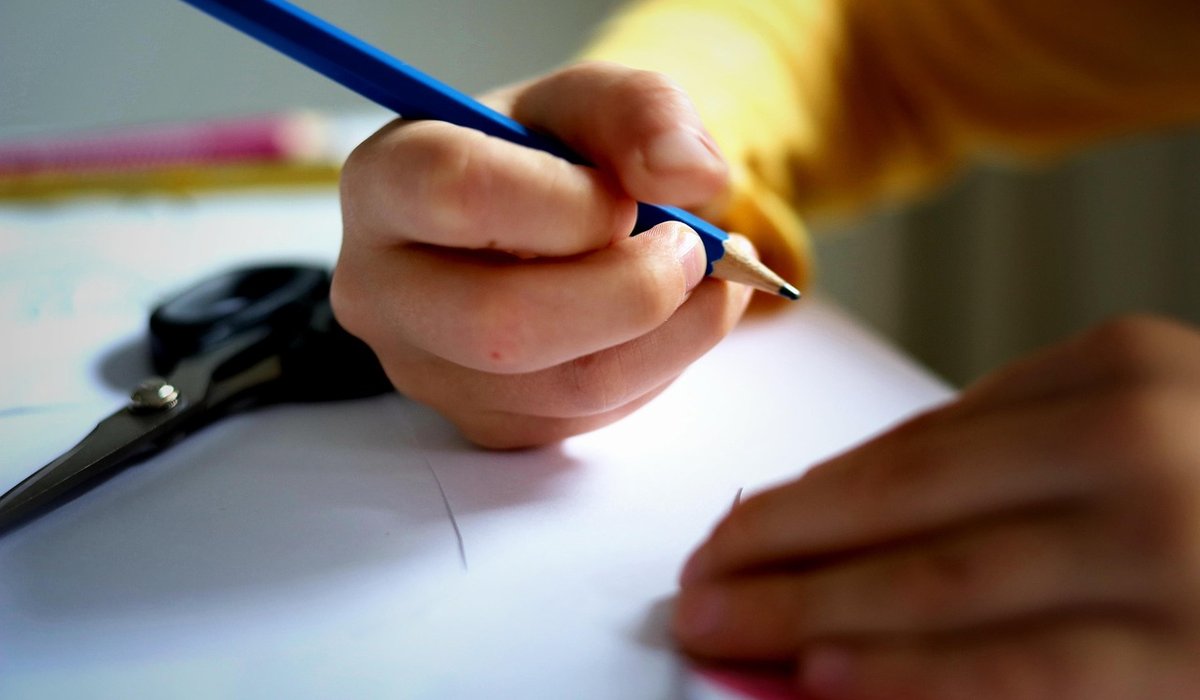
Before any drill, adjust how you hold the pencil. Move your grip back so it sits about four centimetres from the tip rather than one, and let the side of your little finger rest lightly on the paper as a pivot. Lift your elbow off the table. The movement should come mostly from the shoulder and upper arm, with the wrist staying fairly quiet.
Then loosen up physically: shake out your hand, roll your shoulders, take three slow breaths. Finish with thirty seconds of deliberate rubbish — loose scribbles over an A5 page, no intention, no neatness. It looks pointless. It isn't. It tells your hand that this page isn't precious.
Drill One: Dot to Dot, Twenty Times
Draw two dots about ten centimetres apart on a fresh page. Now connect them in a single stroke, drawing from just before the first dot to just past the second. Aim through the second dot rather than at it, the way an archer aims past the target rather than at the arrowhead. Then do it nineteen more times, one line under the other.
The rules matter more than the result: no stopping halfway, no going back over the line to thicken it, no rubbing out. The first few will bow or overshoot. By the fifteenth, most people find the lines landing much closer to the dot, simply because the hand has stopped negotiating.
Once vertical and horizontal lines feel steadier, rotate the page and repeat with diagonals. Then try a version where the dots are only two centimetres apart, so the stroke has to be short and decisive. Shorter strokes expose hesitation faster than long ones.
Drill Two: The Ghost Line
Hover your pencil a centimetre or two above the paper and trace the path you're about to draw — three or four times, without touching down. Then drop the tip and draw it once, for real. This works beautifully on curved shapes: the rim of a mug, the arch of a shoe, the outline of a plant pot.
The hovering gives you a rehearsal without the commitment, and it teaches your arm the shape before your eyes start second-guessing it. If you notice yourself speeding up during the rehearsal, that's your cue to commit — the shape is already in your hand. If you're slowing down and adding more rehearsals, stop and draw it anyway. Three passes is plenty.
Drill Three: Curves, Circles and One Continuous Line
Fill a page with circles, roughly the size of a two-pound coin, drawing each one in a single anticlockwise or clockwise sweep. Don't close the circle slowly and carefully; whip it round and let it overlap slightly. Then fill another page with long S curves, top to bottom, so your whole arm is involved.
Next, a ninety-second continuous line drawing of something real and unglamorous: your keys, a pair of scissors, the kettle. The only rule is that the pencil doesn't leave the paper. The line has to keep travelling, which quietly kills the habit of fussing over one small section while the rest of the drawing waits.
Two variations are worth trying:
- Swap the pencil for a fine-liner or a biro. Without a rubber, you're forced to keep moving and work around mistakes instead of erasing them.
- Do one round with your non-dominant hand. It feels clumsy, but it proves the point: the wobble comes from tension and over-control, not from a lack of ability in your usual hand.
Making It Stick: Five Minutes a Day
None of these drills needs more than five minutes, and they work best as a warm-up before whatever you actually sat down to draw. Keep them on one cheap sketchbook page, date the corner, and turn the page when it's full. In a month you'll have a record of your own improvement, which is far more persuasive than anyone telling you that you've got better.
Expect flat days. Cold hands, tired eyes and a rushed ten minutes before bed will all show up in your lines, and that's fine — the drill still counts. A short routine that survives a busy week beats a long one you abandon by Thursday.
Above all, remember what you're practising. A wobbly line that goes somewhere, drawn with your shoulder and finished without apology, is worth far more than a hair-thin line that hesitates for two centimetres and gives up. Confidence first, accuracy second. It's the right order, and it's the one that keeps people drawing.


John Doe
14 January, 2022Having no content in post should have adverse..
Chauffina Carr
10 April, 2022We use these tests all time! Killer stuff!
Jim Séchen
16 July, 2022Thanks for all the comments, everyone!